
The Danger in a Teacup: On Murder in a Cornish Teashop by Fliss Chester
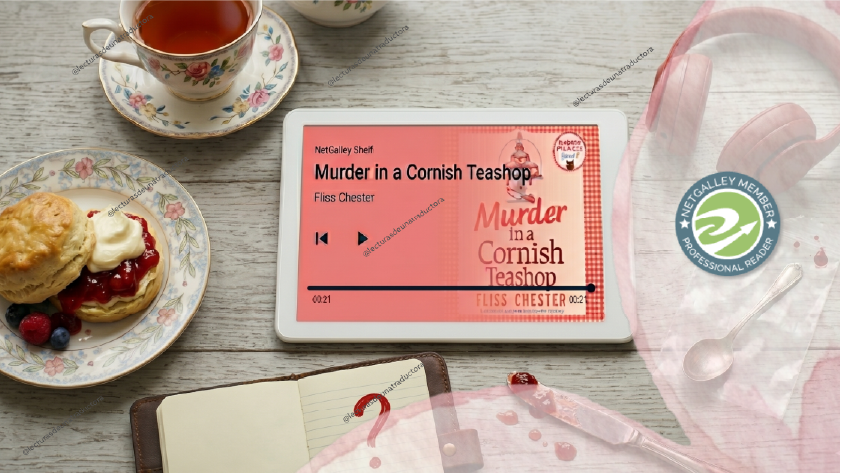
Title | Murder in a Cornish Teashop |
Series | Maddie Penrose — Book 1 |
Genre | Cozy Mystery |
Setting | Cornwall, England (contemporary) |
Author | Fliss Chester |
Language | English (British) |
Narrator | Harrie Dobby |
Publisher | Bookouture Audio |
Publication | March 11, 2026 |
Format | Audiobook (8 hr 20 min) |
Source | ALC by NetGalley |
Reading context
This audiobook arrived through NetGalley as an ALC, and it was among the first I ever listened to. For years before encountering my first cozy mystery, I had been living the aesthetic without having a name for it—Christy Anne Jones, a writer and YouTube content creator I have followed since 2015, had built a world of warmth, quiet beauty, and careful attention to domestic pleasures that I now recognize as the cozy aesthetic. Murder in a Cornish Teashop was the book that gave that sensibility a literary form, and something more: the discovery that mystery does not have to demand the surrender of comfort in order to follow an investigation. I had read mysteries before—tense, adrenaline-driven ones where darkness feels like the natural condition of crime. This was my first encounter with a mystery that refused to choose between warmth and investigation—and in that refusal, I recognized something I had been missing without knowing it.
Narrative analysis
Chester organizes the mystery like a recipe—a structural decision that places Murder in a Cornish Teashop firmly within the fair-play tradition. The clues are laid out like ingredients: measurable, available, waiting to be identified and assembled. The reader who pays attention is given everything needed to reach the solution before it arrives. For the first time in a long while, I identified the killer before the reveal—not through luck, but because the recipe was complete.
At the center of that logic stands Maddie Penrose, a former London chef retreating to her grandmother Nor’s Cornish teashop. Maddie believes in the infallibility of recipes—follow the steps, get the result—and she is the amateur sleuth in the Agatha Christie mold: someone whose relationship to crime-solving derives not from authority but from attention. Her arc, from professional burnout to a slower purpose, from London pressure to a Cornish recalibration she did not entirely plan, develops alongside the investigation rather than separately from it. The recipe logic Chester applies to the mystery mirrors, precisely, the logic Maddie applies to everything.
The cozy mystery as a genre operates on a specific and demanding tension: danger is real, but it is contained within an atmosphere of warmth. The murder exists and its consequences matter. But the setting—the Cornish farm, the teashop, the rhythm of scones and clotted cream—creates a kind of domestic armor around the investigation. This is not tonal inconsistency; it is the genre’s central argument: that life’s warmth and life’s violence are genuine neighbors, and that the village, with all its textures and relationships, is a more honest version of the world than the stripped, atmospheric darkness of the thriller.
Chester handles this balance carefully. The surrounding characters are drawn with specificity and humor—Nor above all, whose voice and personality are two of the book’s most effective instruments. Close behind are Crumpet and Toast, two farm cats whose names carry the full weight of the cozy aesthetic and who provide levity at exactly the right moments, tipping the register from tense toward warm without undermining either.
Linguistic and traductological observations
Listening to Murder in a Cornish Teashop as an audiobook introduces a layer of mediation that the page does not: Harrie Dobby’s narration is itself an act of interpretation. In the absence of a translation—this is the original English text—Dobby’s voice carries the full interpretive weight. The choices she makes about how characters sound, how Cornwall sounds, how humor lands and tension rises, are not decorative; they are the text as the listener receives it.
Dobby differentiates characters effectively throughout, and her handling of Nor is the most striking example. Nor’s voice does not merely accompany the character—it constitutes her. The wit, the warmth, and the particular style of unsentimental affection that Nor brings to the novel come through as much through Dobby’s tonal register as through the words themselves. The subtle management of regional accents across the cast adds authenticity without tipping into caricature—a technically difficult balance to sustain across a full listening experience. Nowhere is that balance more consequential than in the Cornish accent itself.
Cornwall is not simply a scenic county in southwest England—it is a Celtic nation with its own language (Kernewek, related to Welsh and Breton), its own identity, and a centuries-long practice of cultural self-distinction from the rest of England. When that accent is embodied in a narrator’s voice, the listener receives that identity directly and viscerally: it cannot be skimmed, neutralized, or processed through orthographic convention. It simply sounds the way it sounds.
And it is precisely there that typography disappears. Cornish surnames and place names—built on Kernewek phonology, not English convention—arrive as pure sound when heard without the page. The listener must decode them aurally, settling into their unfamiliar phonetic shapes through repetition rather than through reading. That process of aural decoding is its own small experience of cultural difference: the ear learns Cornwall the way a traveler learns a place, gradually and through sound.
This raises a question that sat with me throughout the listening: what would a Spanish translation—and its audiobook version—do with that accent? In a translated audiobook, two interpretive layers have to cohere: the translator’s written decisions (how to signal on the page that these characters speak differently from standard English) and the narrator’s sonic decisions (how to give voice to whatever the translator decided). There is no Spanish regional equivalent that carries comparable associations—Celtic periphery, maritime identity, historical resistance to cultural assimilation—without importing entirely unrelated meanings. The audiobook format makes that challenge visible in a way that a print translation alone does not.
Critical evaluation
Murder in a Cornish Teashop is a precise entry into a genre that is more architecturally demanding than it appears. The warmth is not incidental—it is earned. Chester builds a world in which comfort and danger are genuine neighbors, and the recipe metaphor gives the narrative a formal coherence that elevates it above the merely pleasant. The fair-play tradition requires a protagonist whose attention the reader can trust and a plot constructed honestly enough to reward that trust. Chester delivers both.
This is not a book for readers who require their mysteries to generate fear. The tension operates quietly, in the pauses between cups of tea. It is, however, an excellent entry point for readers approaching the cozy mystery genre for the first time; for those with an interest in Cornwall as setting and cultural context; and for anyone who has suspected that the most important evidence is sitting in plain sight, waiting to be read correctly.
The bonus recipe at the end—heard rather than read, in the audiobook format—confirms that the domestic and the culinary are not atmospheric choices but the book’s deepest commitments. That it cannot be consulted or measured, only listened to once and let go, is perhaps the most cozy thing about it.
Maddie Penrose is only getting started. Murder at the Cornish Book Club publishes June 29, 2026—and with three additional novels since announced by Bookouture, Cornwall has a great deal of mystery left to offer. Enough cups of tea to keep things warm for some time yet.
Advance listening copy received via NetGalley in exchange for an honest review.
El contenido de este blog está protegido por derechos de autor. Para compartirlo en redes sociales, etiquétame en esa red social o menciona la fuente con el enlace original. Para citarlo en publicaciones formales, incluye la referencia bibliográfica completa. Para cualquier otro uso de contenido o imágenes, escríbeme al correo electrónico indicando plataforma, propósito y datos de contacto. Consulta las condiciones de uso.
Únete a la conversación
Querida comunidad, los comentarios son bienvenidos siempre que sean respetuosos y no publicitarios. Consulta las condiciones de uso.