
Two Eras, One Inheritance: On Fishbone Cinderella by Elizabeth Lim
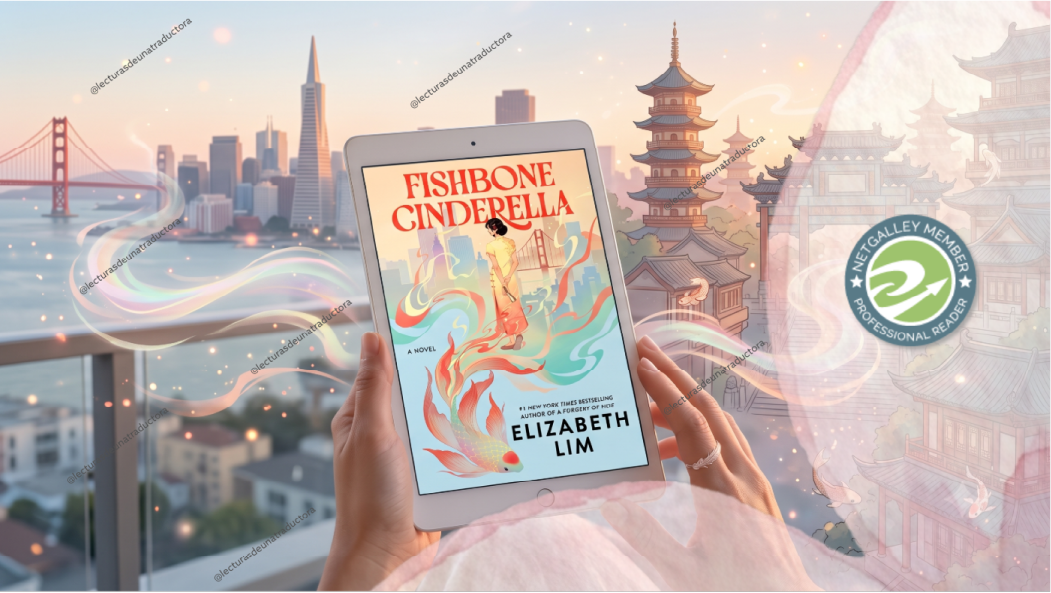
Title | Fishbone Cinderella |
Genre | Historical Fiction |
Setting | Guangzhou, Guangdong, China (1940s) • Hong Kong, China (1940s) • San Francisco, California, United States (1960s) |
Author | Elizabeth Lim |
Language | English (American) |
Publisher | Del Rey Books (Penguin Random House) |
Publication | July 28, 2026 |
Format | E-book (448 pages) |
Source | DRC by NetGalley (Uncorrected Proof) |
Reading context
I received this as a DRC through NetGalley, and I’ll be honest: I hesitated considerably before opening it. The cover carried a prominent notice—Uncorrected Proof, in large letters—and the credits included an explicit restriction against quoting any passages in reviews, as the text would still be subject to revision before publication. That is a more formal constraint than the usual ARC disclaimer, and it gave me pause. I held off for some time before deciding to start. In the end, it was the right call. Whatever final changes the published version may carry, the architecture of this story was already fully in place.
Narrative analysis
Fishbone Cinderella is built around two interlocking timelines. Ha Yut Ying—who becomes Helen—moves through the Japanese invasion of Guangdong in the early 1940s, through displacement into Hong Kong, and eventually into a life rebuilt in the United States. Her daughter Marigold, the second narrative thread, lives the 1960s in San Francisco: a different era, a different country, a different set of silences inherited from a mother whose past she only partially understands. The chapters alternate between them, each timeline advancing independently until the two converge.
This is a structural choice that demands patience and rewards it. Lim uses the separation to build genuine investment in both women before their stories intersect. By the time the convergence arrives, you know each character well enough that the emotional weight of their meeting—and the way one life has shaped the other across decades—lands fully. It is not a structure that shows off; it is one that does exactly what it needs to do.
What strikes me most about the novel’s historical dimension is its specificity. The treatment of the Second Sino-Japanese War does not flatten history into atmosphere. The texture of Guangdong under invasion—by which I mean the concrete, granular details of what daily life looked and felt like for people living inside that historical moment, not the historical fact in the abstract—is rendered with precision. The cultural gap between mainland China and Hong Kong is handled with genuine care: not as a single “Chinese experience,” but as two distinct cultural formations with their own tensions. That distinction matters, and Lim respects it.
The characters sustain the weight the structure places on them. Ha Yut Ying’s arc is written with psychological consistency—she is not simplified into resilience or victimhood, but rendered as a person navigating a set of impossible circumstances with her own specific logic. The secondary cast holds up equally: every character carries their own weight within the story’s world.
One detail that came to light after the novel’s announcement adds a significant layer: the story draws not only on historical research but on family memory. Lim’s grandmother was, in many ways, the real-life origin point for Ha Yut Ying—she lived through the invasion, the displacement, the reconstruction of a life far from home. She told these stories to her granddaughter and, apparently, told her they would make a book. That a family history transmitted across generations became a novel is itself a version of the book’s central subject: what we carry forward, and how, and at what cost.
The integration of the Ye Xian fairy tale—the Chinese Cinderella, predating the European tradition by centuries—is the novel’s most elegant structural decision. I did not know this story before reading this book. Discovering it here, woven into the narrative rather than appended to it, was one of the more satisfying reading experiences I’ve had recently. Lim does not use the fairy tale as ornament. It is structurally and thematically operative, and the ending—which I will not describe—refuses the resolution the Cinderella template would seem to promise. That refusal is not a flaw. It is the novel’s most honest gesture.
As for the novel’s fantastical dimension: it is present from the very first pages, but not loudly. The magical thread is introduced almost imperceptibly, woven into the historical fabric of the story rather than announced as a separate mode. The reader intuits that something exceeds the ordinary before fully understanding what it is. Its nature is revealed gradually, and the reasons behind it take even longer to surface. This is a deliberate technique: the magic is never separate from the history. Both grow together, at the same pace, and the reader’s understanding of their relationship deepens over time rather than arriving in a single explanatory moment.
On language and the translator’s eye
Reading this novel as a translator and interpreter, one element kept surfacing throughout: the novel tells us explicitly that Helen does not speak English. She never learns it. Her entire adult life in the United States is lived in her mother tongue, mediated through her children and husband, conducted in a language the book’s prose never renders directly.
And yet every word she thinks, speaks, and perceives is given to us in English.
This is the monolingual convention of literary fiction: a practical concession that allows a text to reach its intended readership without constant interruption. It is not a flaw. It is a choice, and a longstanding one. But it is the kind of choice that becomes visible when you read with a translation background, because it is, in effect, a silent act of linguistic mediation that the text performs on its own characters.
The linguistic reality of this novel is primarily bilingual. Cantonese—the language of Guangdong and of Hong Kong’s majority Chinese population—is the mother tongue of Ha Yut Ying and of nearly every character she is close to. In the specific historical context of colonial Hong Kong, Cantonese was the language of daily life, while English was the colonial language: the language of administration, prestige, and social advancement. The novel makes this tension explicit—Helen’s inability to speak English is not simply a personal limitation but a marker of social position, and the distance between those who speak it and those who do not structures much of the hierarchy she encounters throughout her life.
A Spanish translator would receive a novel where the interior world of a Cantonese-speaking character has already been rendered entirely in English—the author’s language and the novel’s medium. That translation into Spanish would be a second act of linguistic transposition, operating on a text that has itself already absorbed the distance between the character’s language and the narrative’s language. The Ye Xian fairy tale compounds this further: a story of Chinese origin, already embedded in an English-language novel, would require a translator who carries not only the plot but the cultural weight of a tradition many readers in the target language may have no access to.
I noticed this most in the scenes set in Hong Kong, where the social texture of the city—the class dynamics expressed through language, the particular prestige of English in a colonial context—is present in the story but necessarily flattened in the prose. That flattening is not a failure of the writing. It is an inherent limit of the monolingual convention. It is also one of those places where the translator’s eye notices something the general reader’s eye does not need to.
Critical evaluation
Fishbone Cinderella is Elizabeth Lim’s adult debut, and it reads like a novel that was a long time in the making in the best possible sense. The structural confidence, the depth of research, the sustained emotional range—none of it feels like it is being demonstrated. It feels earned. The novel has its own identity, which is rarer than it should be.
The ending is its own thing. It is not the comfortable ending, not the expected one, but the one that honors what the novel has actually been doing all along. There is a particular kind of earned surprise that separates a genuinely good book from a competent one—the surprise that, when you think it back through, feels inevitable. This is one of those.
Recommended for readers who want their historical fiction to do more than recreate atmosphere; for anyone interested in Chinese history and diaspora experience as lived reality rather than spectacle; and for those who read fairy tales and wonder what they cost.
Advanced copy received via NetGalley in exchange for an honest review. No direct quotes have been included, as this is an uncorrected proof and the credits explicitly restrict their use prior to publication.
Como Afiliada de Amazon, recibo una comisión por las compras que cumplan los requisitos aplicables, sin costo adicional para ti.
El contenido de este blog está protegido por derechos de autor. Para compartirlo en redes sociales, etiquétame en esa red social o menciona la fuente con el enlace original. Para citarlo en publicaciones formales, incluye la referencia bibliográfica completa. Para cualquier otro uso de contenido o imágenes, escríbeme al correo electrónico indicando plataforma, propósito y datos de contacto. Consulta las condiciones de uso.
Únete a la conversación
Querida comunidad, los comentarios son bienvenidos siempre que sean respetuosos y no publicitarios. Consulta las condiciones de uso.