
What a Narrator Doesn't Tell You: On The Housewife by Natalie Barelli
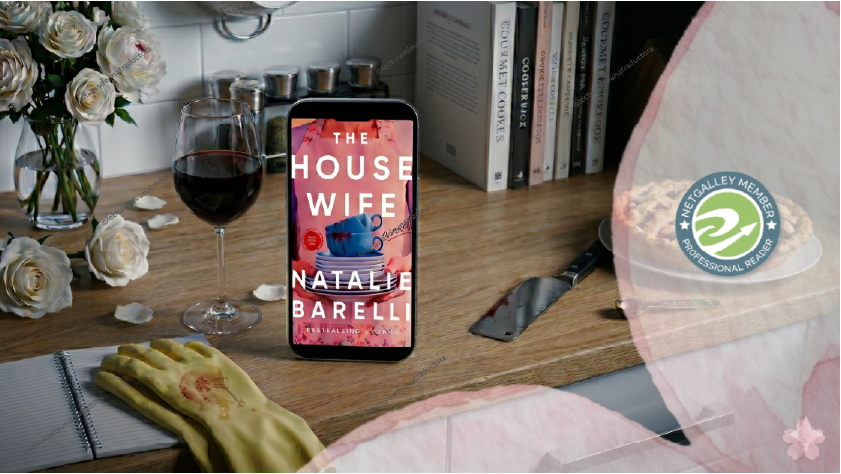
Title | The Housewife |
Genre | Thriller • Psychological Thriller • Domestic Thriller |
Setting | Beverly Hills, California (contemporary) |
Author | Natalie Barelli |
Language | English (American) |
Publisher | Poisoned Pen Press |
Publication | June 30, 2026 |
Format | E-book (368 pages) |
Source | DRC by NetGalley (Final Manuscript) |
Reading context
I requested this DRC back in February and let it sit in the queue for months. It was only when I started noticing members of my reading community picking it up—people whose judgment I trust, people who were visibly unable to stop—that I moved it to the top. I started on Saturday night, intending to read just enough to get a feel for it. I finished at 1:11 a.m. on Monday. I grew up reading Agatha Christie—my father gave me volumes from his own shelves, and I became obsessed with the act of solving before the solution arrived—and this novel gave me exactly that feeling: the pleasure of being one step behind the story, always trying to keep up.
Narrative analysis
The Housewife is narrated entirely in first person by Jodie, who is both the protagonist and the only voice through which everything in the novel is filtered. This is what narratology calls a homodiegetic narrator: a narrator who is also a character within the story they are telling.
Jodie’s narration works in two registers at once. She has access to her own inner world—thoughts, observations, moments of sharp humor, emotional undercurrents—and she also moves through fully dramatized scenes: dialogues she participates in, conversations she overhears, events she witnesses as they unfold. In the scenic passages, the reader receives the dialogue directly, not as Jodie’s retrospective summary of what was said. Other characters speak in their own voices. What Jodie controls throughout is something more structural: which scenes exist at all, how they are framed, what she notices before and after them, and the silences between them. The blind spots in her narration are not in how she reports what others say—they are in what she chooses, consciously or not, to show the reader and what she leaves out altogether.
This is what makes the homodiegetic form so precise and powerful here. The reader can follow a scene in full—hear the dialogue, observe the action—and still be working with an incomplete picture, because the architecture of what is included and excluded belongs entirely to Jodie. You experience events alongside her, but within a frame she has built around them. The limits of that frame are the limits of what you know.
Jodie herself is the novel’s most significant achievement. She is built around a central contradiction that the novel never fully resolves, which is exactly right: she is deeply insecure and quietly capable at the same time, oscillating between a profound sense of inferiority—the outsider, the second wife in a house that still carries someone else’s history—and a surprising, unsettling confidence in her own ability to act when she decides that action is required. This oscillation is psychologically consistent. She does not feel like a character designed to illustrate a theme; she feels like a person whose contradictions are entirely her own.
The domestic setting—the perfect Beverly Hills house, the practiced routines of the ideal wife, the performance of contentment—is used not as backdrop but as the novel’s main site of tension. Jodie wants this life, has wanted it, and is simultaneously aware that it is a construction, that she is performing it, and that the man at the center of it may not be who she believed him to be. The pressure between those three positions—desire, performance, and growing suspicion—is what drives the story forward.
The tonal range of the prose deserves specific attention. Jodie’s voice moves between registers that should be incompatible and aren’t: she can describe something genuinely dark—a violent act, a calculated manipulation—in the same dry, slightly detached tone she uses to narrate a domestic routine. The effect is deeply uncomfortable in the way that good dark humor always is. You find yourself laughing at something you probably shouldn’t be laughing at, and that discomfort is productive—it keeps you slightly off-balance throughout, which is precisely the point. The comedic moments do not undercut the novel’s darkness; they deepen it, because they are evidence of how thoroughly Jodie has internalized a certain kind of dissociation between what is happening and how it feels.
The pacing reflects the same structural care. This is not a thriller that holds everything back for a final act. Revelations arrive steadily across the narrative, which means the tension accumulates rather than building to a single release. I caught some things before they were formally disclosed. The ending caught me completely off guard regardless.
On language and the translator’s eye
Voice is what makes or breaks a first-person psychological thriller in translation, and Jodie’s voice is the kind that would give a translator serious pause—not because it is impossibly idiosyncratic, but because its effect depends on calibration so precise that any shift in register becomes a structural problem.
The dark humor, specifically, is translation-resistant in a way worth examining carefully. It functions through the gap between subject matter and tone: the content being described is genuinely disturbing, but the tone treats it as entirely ordinary—matter-of-fact, casual, unremarkable. The darker the subject, the more deliberate the flatness, and the wider the gap becomes. This is what English literary criticism calls deadpan understatement: the delivery is completely expressionless (deadpan) and describes something serious as though it were far less significant than it actually is (understatement). The humor is generated entirely by the reader’s perception of that gap—the recognition that what is being described and how it is being described have nothing to do with each other.
English has a long and developed relationship with this tonal tradition. It functions quietly, without signposting its own irony. Spanish has its own rich traditions of dark humor—but they tend to operate through different mechanisms: through hyperbole, through a particular kind of bitter expressiveness, through a darkness that announces itself rather than slipping underneath the surface of the prose. A translator rendering Jodie’s voice would face a problem that is not primarily lexical. The question is not which words to choose, but which tonal tradition to invoke and how to reconstruct the effect of a gap that functions differently in the target language. That is a genuine challenge from a translatological perspective.
The word "Housewife" sits in contemporary English at the intersection of several registers simultaneously: domestic, gendered, slightly archaic in some uses, reclaimed and ironic in others. Jodie is someone who has built an entire identity around the desire to be exactly this—a housewife, in the fullest and most deliberate sense of the word—and who is also, by the end of the novel, something far more complicated than that word can contain. The title’s irony depends entirely on that semantic complexity. “Ama de casa” in Spanish is functional and neutral; it does not carry the same historical freight or the same current ambivalence. Finding an equivalent that reconstructs that tension would be one of the first and most defining decisions of any translation—a genuine challenge from a translatological perspective.
Critical evaluation
The Housewife is a tightly constructed domestic thriller with one of the more fully realized first-person voices I have encountered in this genre in some time. Barelli doesn’t simply choose the homodiegetic form because it is conventional for thrillers; she exploits every structural implication of the device, making sure that the reader’s disorientation is not incidental but purposeful. The result is a novel in which what you don’t know feels as carefully managed as what you do.
Jodie is the novel’s strongest element and its biggest risk: everything depends on whether the voice works, and it does. She is flawed, funny, disquieting, and oddly sympathetic in ways that resist easy explanation. You find yourself invested in a character you cannot fully endorse, which is exactly the right position for a thriller of this kind to put its reader in.
Highly recommended for readers who approach thrillers as active participants—who read to solve as much as to be surprised; for anyone with an interest in the craft of the unreliable narrator; and for those who find dark humor most effective precisely when it barely announces itself.
Advanced copy received via NetGalley in exchange for an honest review.
El contenido de este blog está protegido por derechos de autor. Para compartirlo en redes sociales, etiquétame en esa red social o menciona la fuente con el enlace original. Para citarlo en publicaciones formales, incluye la referencia bibliográfica completa. Para cualquier otro uso de contenido o imágenes, escríbeme al correo electrónico indicando plataforma, propósito y datos de contacto. Consulta las condiciones de uso.
Únete a la conversación
Querida comunidad, los comentarios son bienvenidos siempre que sean respetuosos y no publicitarios. Consulta las condiciones de uso.